A battery pack that cuts out early, charges unusually slowly or shows one series group at a noticeably different voltage has a cell-balance problem worth investigating. What causes cell imbalance is rarely one thing alone. It is usually a combination of cell matching, pack construction, load conditions, age and the limits of the battery management system (BMS).
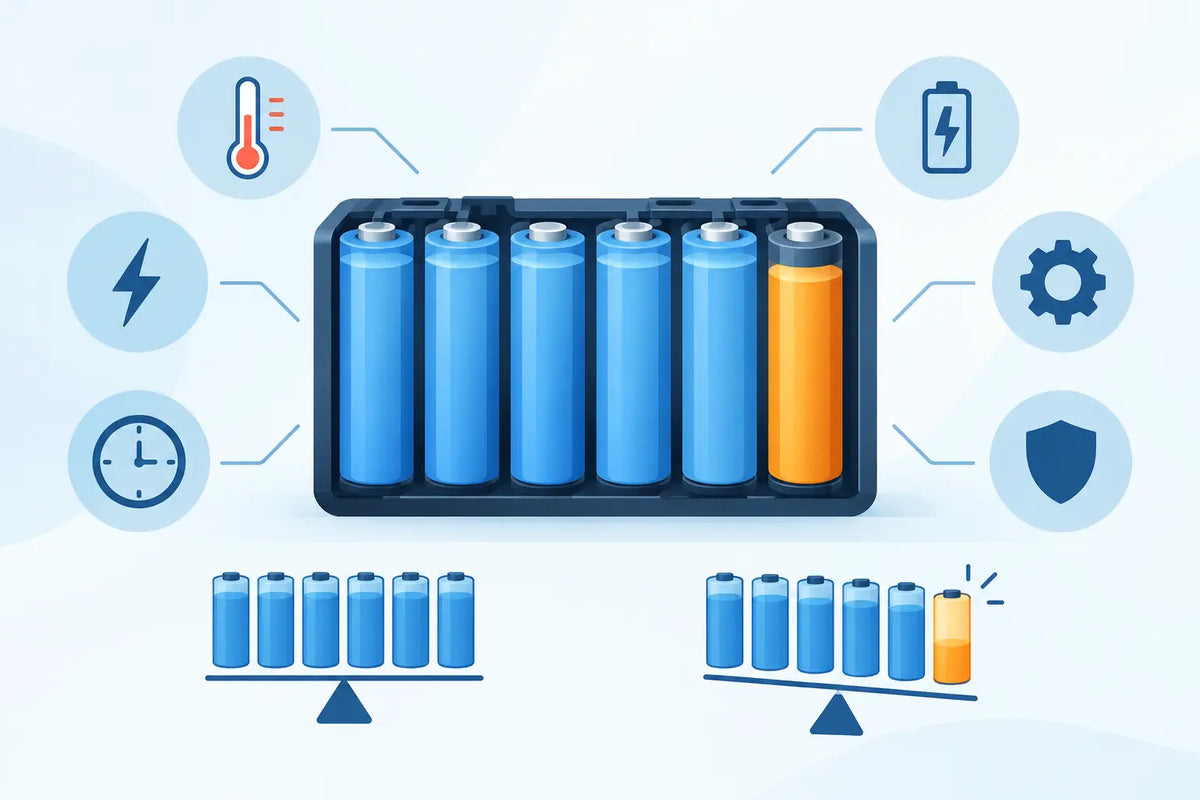
In a lithium-ion pack, cells connected in parallel act as one group, while those groups are connected in series to raise voltage. Balance refers to how closely the series groups track one another in state of charge and usable capacity. When one group reaches empty or full before the others, it sets the practical limit for the entire pack.
What Causes Cell Imbalance in a Lithium-Ion Pack?
The most common cause is a difference in usable capacity between series groups. A group with less capacity reaches its low-voltage limit first during discharge, even if the rest of the pack still holds plenty of energy. On charge, that same group can reach the upper voltage limit before the others, causing the BMS to stop charging or begin balancing.
Voltage alone does not tell the whole story. A group can look close to the others at rest but sag much further under load because it has higher internal resistance. That resistance turns more energy into heat and makes the group appear flat earlier than a healthy group. This is why a pack may run a torch or low-current device normally, then cut out as soon as an e-bike, scooter or high-drain tool demands current.
Mismatched cells from the start
A pack is easiest to keep balanced when all cells are the same model, capacity, age and condition. Mixing a high-capacity 18650 with a high-drain 18650 may seem reasonable if their nominal voltage is the same, but they can have very different discharge curves and internal resistance. The same issue applies when mixing 21700 cells from different manufacturers or batches.
Using reclaimed cells raises the risk further. Cells removed from different laptop packs, power tools or vapes may have experienced completely different heat, charge cycles and storage conditions. Their printed capacity may match, but their remaining capacity often does not. A pack built from cells that are electrically mismatched will drift out of balance quickly.
Starting cells at different voltages is another avoidable cause. Before assembling parallel groups, cells should be brought to a closely matched voltage. Connecting cells with a large voltage difference can create a very high equalisation current between them. It can stress the cells, nickel strip and welds, while also leaving the pack difficult to assess from the first cycle.
Ageing, heat and hard use
Lithium-ion cells do not age at exactly the same rate. One group may run warmer because it sits near a motor controller, charger, enclosure wall or another heat source. It may also carry more current if a poor connection increases resistance elsewhere in the pack. Repeated heat exposure accelerates capacity loss and resistance growth.
Deep discharge and high-current operation can widen the difference between groups over time. A cell selected for energy capacity may perform well in a low-drain power bank but be unsuitable in a high-current pack. If it is repeatedly pushed beyond its sensible continuous-discharge rating, it will heat up, sag harder and age faster than the rest of the pack.
Storage matters as well. Leaving a pack fully charged for long periods, especially in a hot shed, car or ute tray, increases calendar ageing. A pack stored almost empty can also be damaged if one weaker group self-discharges below a safe voltage before the rest. The result may be imbalance that cannot be corrected by routine balancing.
Uneven self-discharge or a damaged cell
A healthy lithium-ion cell self-discharges slowly. A cell or parallel group that loses voltage much faster than the others may have internal damage, contamination, a separator fault or abnormal leakage. In a series pack, that group becomes progressively lower during storage even when nothing is connected.
Physical damage is a serious possibility. Dented cans, torn wraps, corrosion, heat discolouration, swelling, burnt nickel or a chemical smell are not balance issues to solve with a charger. Treat them as pack faults. Stop using the pack and do not try to revive a damaged cell by forcing charge into it.
Pack Construction Faults That Look Like Cell Imbalance
Not every apparent imbalance is caused by the cells themselves. A weak spot weld, cracked nickel strip, corroded connection or undersized current path can add resistance to one group. Under load, the BMS may see a bigger voltage drop at that point and shut the pack down early. Once the load is removed, the voltage can rebound and make the fault seem mysterious.
BMS sense wiring deserves equal attention. Each balance lead must connect to the correct series point in the correct order. A loose, damaged or wrongly connected sense wire can cause false voltage readings, failed balancing or permanent BMS damage. Never assume a BMS is at fault until the actual group voltages have been measured carefully with a multimeter.
Poor insulation and layout can also create intermittent faults. Fish paper rings, cell spacers, insulating barriers and properly routed balance leads are not cosmetic extras. They help prevent vibration damage and shorts that can turn a repairable pack problem into a dangerous failure.
When the BMS Cannot Keep Up
Most common BMS units use passive balancing. When a group reaches a set voltage near the top of charge, the BMS bleeds a small amount of energy from that group as heat. Balance current is often modest compared with pack charge current. If one group is only slightly high, leaving the pack on the correct charger after it reaches full may allow the BMS to gradually bring it into line.
However, passive balancing is not a repair tool for a large capacity difference. A BMS bleeding tens of milliamps cannot compensate for a group that is hundreds of milliamp-hours weaker, has excessive self-discharge or drops sharply under load. It may also only balance near full charge, so a pack can remain substantially uneven through most of its operating range.
Check the BMS specification before expecting balancing behaviour. Some units balance continuously, some only during charging, and some have no balancing function at all. The number of series groups, chemistry setting, charge voltage and current rating must suit the pack. A 10S BMS is not interchangeable with a 13S BMS simply because both are used in lithium-ion projects.
How to Diagnose an Imbalanced Pack
Start by recording the voltage of every series group at rest, using the BMS balance connector or accessible cell-group tabs. Then repeat the readings after a controlled charge and, where safe and practical, after a known load. The group that consistently reaches the highest voltage first on charge or the lowest voltage first on discharge is the one to investigate.
A single reading is only a clue. Allow the pack to rest before comparing group voltages, because voltage rebound after load can hide weakness. Also check the difference under load. A group that looks normal at rest but falls away under moderate current may have high internal resistance, a poor weld or both.
For a proper rebuild assessment, test cells individually for capacity and internal resistance with suitable equipment. Capacity testing should use a conservative discharge current appropriate to the cell and tester. Internal-resistance figures vary with tester type, lead resistance, state of charge and temperature, so use them mainly to compare like with like rather than treating one number as absolute.
If a group contains parallel cells, do not replace one cell in isolation unless you have established that the others are healthy and closely matched. In most practical repairs, replacing the complete parallel group with matched cells is the safer approach. Never add a new cell in parallel with heavily aged cells and assume it will carry the whole group.
Fix the Cause, Not Just the Voltage Difference
A small imbalance in an otherwise healthy, correctly built pack may settle with a full charge cycle and adequate time for the BMS to balance. A recurring imbalance needs a different response. Find the weak group, inspect the nickel and welds, verify every BMS sense connection, and test the cells rather than repeatedly topping up the low group.
Do not bypass the BMS, charge a series group with an unsuitable charger or use improvised wiring to force cells into line. Lithium-ion cells require the right charge profile and close supervision. If a cell group is below the manufacturer’s recommended minimum voltage, visibly damaged or heating during charge, replacement is generally the sensible option.
For new pack builds, begin with genuine, matched cells selected for the real current demand. A capacity-focused cell suits a low-drain application; a high-discharge cell is the better choice where motor loads or power tools demand sustained current. TinkerTech AU stocks cells, BMS units, nickel strip and insulation supplies that make it easier to match the pack design to the job instead of asking one cell type to do everything.
The best balance strategy is simple: build with matched cells, use a correctly specified BMS, keep the pack cool and investigate the first signs of drift. A battery pack should not need constant correction to stay usable. When it does, the voltage difference is telling you to look for the underlying fault.