
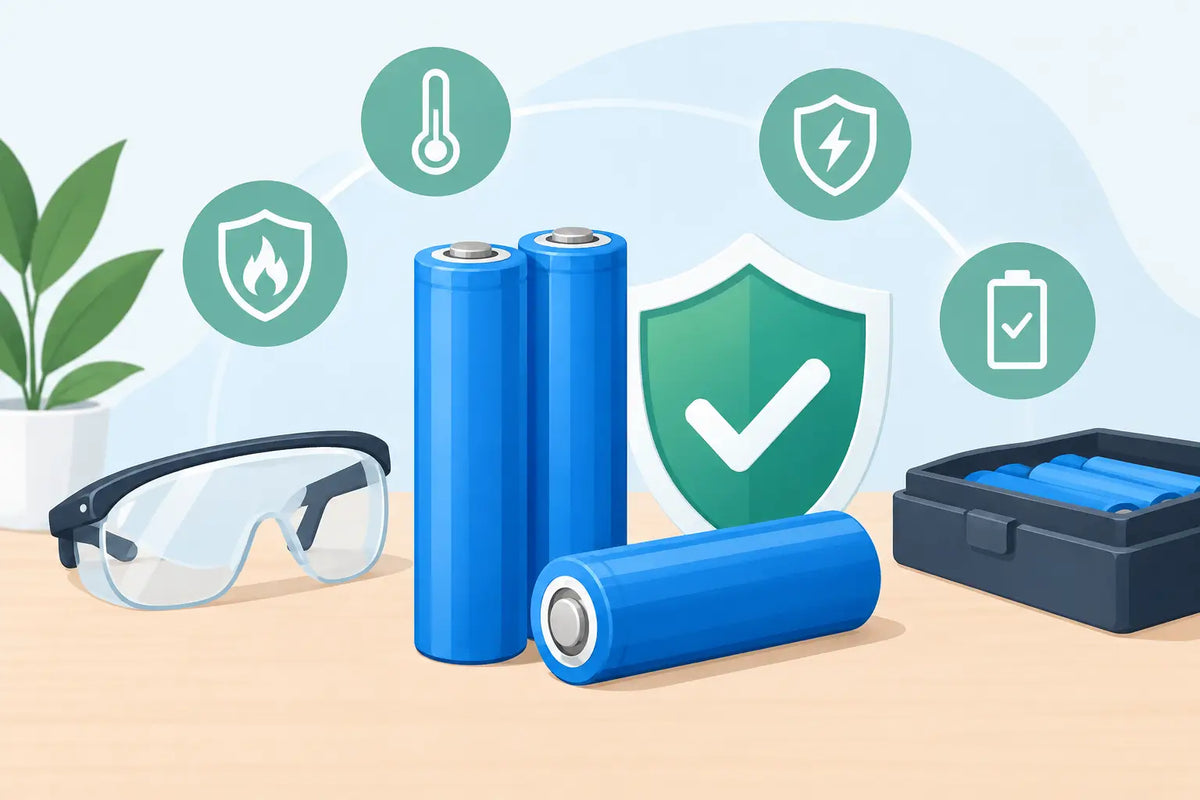
An 18650 cell is not inherently dangerous, but it is a high-energy lithium-ion cell that must be selected, charged and handled correctly. So, are 18650 cells safe? Yes, when genuine cells are used within their specified limits and protected from damage, heat, short circuits and incorrect charging. The risk rises quickly when loose cells are treated like ordinary AA batteries, when reclaimed cells are mixed into packs, or when a high-drain application is supplied by a cell chosen only for its mAh rating.
For makers, repairers and anyone building portable power, safety starts before the cell reaches the charger. The right format, chemistry, discharge rating and protection method matter just as much as capacity.
What makes an 18650 cell safe or unsafe?
An 18650 is a cylindrical lithium-ion rechargeable cell, usually 18 mm in diameter and 65 mm long. A typical cell stores far more energy than a household alkaline battery. That makes it useful in torches, battery packs, tools, e-bike systems and custom electronics, but it also means a fault can release a great deal of heat very quickly.
A quality 18650 has several built-in safety features. These commonly include a pressure-relief vent, an internal current interrupt device and a separator designed to limit internal failure. These features reduce the consequences of abnormal conditions, but they are not a licence to abuse the cell. A hard short circuit, overcharge, crush damage or severe overheating can still cause venting, fire or thermal runaway.
The cell's outer wrap is also part of its safety system. The metal can underneath is the negative terminal. If the wrap is torn, a loose cell can short against a metal object or a battery holder. A damaged wrap, especially around the positive end, should be rewrapped before use or the cell should be removed from service.
Are 18650 cells safe in everyday devices?
They can be very safe in a properly designed device. A good torch, power bank or battery pack is designed around the cell's voltage and current limits. It uses suitable contacts, insulation, wiring and, where required, electronic protection.
For a single-cell device, a protected 18650 can be a sensible choice where space allows. Protected cells have a small protection circuit attached to the cell that can disconnect it during overcharge, over-discharge, over-current or short-circuit events. They are useful for lower-current devices designed to accept their extra length.
Protection circuits are not suitable for every job. High-drain devices and multi-cell battery packs often use unprotected cells because the required current exceeds what a protection board can pass. In those applications, safety must come from the complete system: correctly matched cells, a properly rated BMS, suitable fuse protection where appropriate, and wiring that can handle the load.
A protected cell will not make an incompatible device safe. Never force a longer button-top or protected 18650 into a battery compartment designed for a flat-top unprotected cell. Excess pressure on the contacts can damage the cell, holder or device.
Choose the cell for current, not just capacity
One of the most common selection errors is choosing the highest advertised capacity without checking continuous discharge rating. A 3500mAh cell may be excellent in a low-current torch or storage project, while a 3000mAh high-drain cell may be the safer option for a power tool, vape device or compact motor load.
Every cell has a continuous discharge rating, expressed in amps. This is the current it can deliver continuously without exceeding its operating temperature limits under specified conditions. If a device draws more current than the cell is rated for, internal heating increases. Voltage sag, reduced runtime, accelerated ageing and potential failure can follow.
Use the device's actual current requirement, not a guess based on wattage claims or marketing labels. For a multi-cell pack, calculate current per parallel group and allow a sensible margin. If the job needs a high current output, select genuine high-drain cells from an established manufacturer rather than an unknown cell with an unrealistic capacity and amp figure printed on the wrap.
Be wary of 18650 cells claiming extraordinary capacities. Genuine 18650 capacity is limited by the physical volume and chemistry of the format. Claims well above established manufacturer specifications are a clear warning sign, particularly where the price is unusually low.
Charge 18650 cells with the right equipment
Lithium-ion cells need a charger made for lithium-ion chemistry. A suitable charger follows a controlled constant-current, constant-voltage charging process and terminates at the correct voltage, normally 4.2V for standard lithium-ion 18650 cells.
Do not charge loose 18650 cells in a charger intended only for NiMH, NiCd or lead-acid batteries. Do not use improvised wiring, bare crocodile clips or a generic power supply without a proper lithium-ion charge controller. These shortcuts remove the controls that prevent overcharge.
A quality multi-slot charger is useful because it monitors each cell separately. This matters when cells have different charge states or capacities. If you are charging matched cells that will be used together in a pack, keeping them at similar voltages is still good practice before assembly.
Charge on a hard, non-flammable surface, away from paper, fuel, solvents, bedding and direct sunlight. Avoid charging unattended or overnight. The point is not to watch a charger nervously for hours, but to ensure that if something unusual happens, you can disconnect power and manage it early.
Stop using a cell if it becomes excessively hot while charging, develops a sweet or chemical smell, swells, leaks, hisses or shows visible damage. A mildly warm cell can be normal under charge or load. A cell that is too hot to handle comfortably is not normal.
Loose-cell handling matters more than people think
Most avoidable 18650 incidents involve loose cells shorting in transit or storage. A cell placed in a pocket with keys or coins can discharge at an extremely high rate through the metal objects. That can heat the cell within seconds.
Store and carry loose 18650 cells in a purpose-made plastic case or insulated holder. Keep the positive terminal covered and do not allow cells to roll around in toolboxes, gloveboxes or drawers. If you need to transport multiple cells, use holders that keep each cell separated.
Before use, inspect each cell. Check for torn wraps, dents, corrosion, leakage, damaged insulator rings and signs that the positive terminal has been pushed down or distorted. The small insulating ring around the positive terminal is particularly important. Replace it when rewrapping a cell.
Do not use a damaged cell in a battery pack just because it still holds charge. It is not worth building a weak point into a pack that may be mounted in a scooter deck, a tool enclosure or inside a finished project.
Build packs as a system, not as a collection of cells
Battery packs need more than cells connected in series and parallel. Cells in the same pack should be the same model, capacity, age and condition. Ideally, they should be purchased together and measured before assembly. Mixing old and new cells, different brands, or high-drain and high-capacity models creates imbalance because their internal resistance and discharge behaviour differ.
For series packs, use a BMS designed for the exact series count and current requirement. The BMS monitors individual cell groups and provides overcharge, over-discharge and balancing functions. Select a BMS based on realistic continuous current, peak current and the application voltage, not just the lowest-cost listing.
Spot welding is the normal method for joining cylindrical cells. Soldering directly to a cell can transfer damaging heat into the can if done poorly or for too long. Use suitable nickel strip, proper insulation rings, fish paper where needed, secure cell spacers and strain relief on output leads. A neat pack is not merely cosmetic - it prevents abrasion, vibration damage and accidental shorts.
If a pack has been dropped, water damaged, overheated or has stopped behaving normally, isolate it. Do not keep charging it in the hope that it recovers. Diagnose the individual groups with appropriate equipment or have a competent battery technician assess it.
A practical 18650 safety check
Before putting an 18650 cell into service, confirm these basics:
- The cell is genuine, correctly specified and suitable for the device's continuous current draw.
- The wrap and positive-end insulator are intact, with no dents, swelling, corrosion or leakage.
- The charger supports lithium-ion 18650 cells and charges each slot independently.
- Loose cells are carried in a case, never loose in a pocket, bag or toolbox.
- A multi-cell pack uses matched cells, a correctly rated BMS and proper insulation.
When to retire an 18650 cell
Cells do not last forever. Retire a cell that has physical damage, repeated overheating, swelling, leakage, a badly torn wrap, significant capacity loss or unusually rapid voltage drop under a normal load. A cell that reads very low after being left unused may have been over-discharged and should be treated cautiously rather than immediately recharged.
Do not put lithium-ion cells in household rubbish or kerbside recycling. Tape the terminals, place the cell in a non-conductive bag or case, and take it to a suitable battery recycling collection point. This prevents short circuits during transport and keeps recoverable materials out of landfill.
Good 18650 safety is mostly practical discipline: buy cells with believable specifications, match the cell to the load, use the correct charger, protect the wrap and build packs with the same care you would apply to any other high-current electrical system. For a project that needs cells, chargers, BMS units and pack-building supplies, getting the whole setup right from the start is cheaper than troubleshooting a failed pack later.