
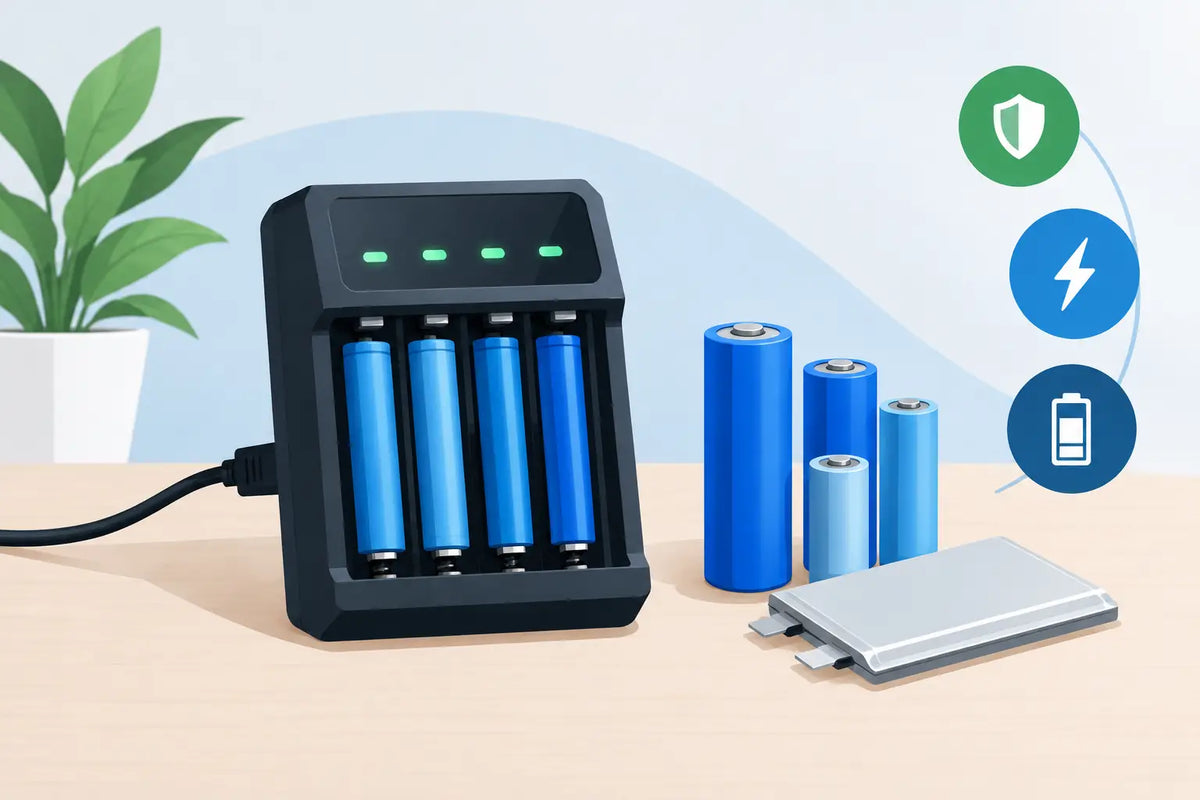
A charger is not a generic accessory. It sets the charge voltage, controls charge current and determines whether your 18650, 20700 or 21700 cells are being treated correctly. To choose lithium charger equipment with confidence, start with the exact cell chemistry and format you own, then match the charger to how many cells you need to charge and how quickly you genuinely need them ready.
For single cylindrical cells used in torches, tools, vape devices, battery storage and DIY projects, an independent-slot lithium-ion charger is usually the practical choice. For a custom battery pack, charging is normally handled through the pack's BMS and a charger designed for that pack voltage. These are different jobs, and confusing them can damage cells or create a serious safety risk.
Start with battery chemistry, not cell size
Most 18650, 20700 and 21700 rechargeable cells sold for high-drain and general-purpose applications are lithium-ion cells with a nominal voltage of 3.6V or 3.7V. They are normally charged to 4.20V per cell using a CC/CV charging profile: constant current first, then constant voltage as the cell approaches full charge.
That does not mean every cylindrical lithium battery uses the same charging voltage. LiFePO4 cells are typically 3.2V nominal and require a 3.65V charge limit. Some older lithium chemistries, specialist cells and rechargeable lithium-titanate cells have different requirements again. A charger set to 4.20V is not suitable for a LiFePO4 cell unless it has a specific 3.65V mode.
Read the printing and specifications for the cells before buying a charger. Do not rely on physical size or colour. A green 18650 can be a high-capacity 10A cell, a high-drain 30A cell or a different chemistry entirely. The charger needs to suit its chemistry, while the cell's discharge rating needs to suit the device or pack.
Choose a lithium charger with independent channels
For loose cells, independent charging channels are one of the most useful features. Each slot monitors and charges its own cell instead of treating two or four cells as one matched group. You can charge a single 21700, two partially discharged 18650s or a mix of compatible sizes at the same time, provided the charger supports them.
Independent slots also reduce the problems caused by cells entering the charger at different voltages. In a basic paired-slot charger, the cells may share a charge circuit. If one cell is much lower than the other, charging can be less controlled. Matched cells used together in a series pack should still be charged and maintained as a matched set, but independent channels add a worthwhile layer of flexibility and visibility.
A useful charger should show at least charging status. A display that reports voltage, selected current and mAh returned to the cell can be helpful for makers assessing cell condition. It is not a laboratory capacity test, but it can flag a cell that takes unusually little charge, behaves differently from its matched partners or fails to reach normal voltage.
Match the slot size to your cell format
Do not assume an 18650 charger will comfortably fit every 21700. Cell length varies with format and construction. Flat-top cells are shorter than protected button-top cells, and protection circuits can add several millimetres. A charger may accept a bare 21700 but not a long protected 21700, or it may have tight slots that make larger cells awkward to insert.
Check the charger's stated supported dimensions, particularly if you use protected cells. This matters for torch users and beginners because protected button-top cells are common in devices that need a longer cell. It also matters for high-capacity 21700 cells, which can be wider than older 18650-focused chargers were designed around.
For most home users, a four-slot charger offers a good balance of bench space and flexibility. Two slots can be enough for a single torch or a pair of spare cells. If you rotate several devices, maintain battery storage or work on packs regularly, four bays avoid turning charging into a queue. Larger multi-slot chargers suit higher cell volume, but only if the available current is properly shared across all occupied slots.
Charge current: faster is not always better
Charge current affects turnaround time, heat and long-term cell wear. A higher current can be convenient, especially with 4000mAh or 5000mAh 21700 cells, but it is not automatically the right setting. Cells have a specified maximum charge current, and the charger's setting must stay within it.
For general-purpose charging, around 0.5A to 1A is a sensible, conservative range for many 18650 cells. A 1A setting is also suitable for many 21700 cells, though it will take longer to fill their larger capacity. Where both the cell specification and charger allow it, 2A can be useful for a quality high-capacity or high-drain cell when time matters.
Lower current is often preferable for smaller cells, older cells, cells that are warm from recent use, or overnight charging where speed provides no benefit. It also puts less stress on cells over repeated cycles. Conversely, very low current can be impractical if you are charging several large cells for regular use. The right answer depends on the cell's data, its condition and your use case.
Never choose charge current from the cell's continuous-discharge rating. A 35A or 45A discharge rating tells you what the cell can supply to a load. It does not mean the cell should be charged at 35A. Charge and discharge limits are separate specifications.
Look for the safety features that matter
A quality charger should terminate charging correctly at the selected voltage and provide protection against common errors. Reverse-polarity protection is useful when loading cells, while short-circuit and overcharge protection help address faults. Temperature monitoring can add protection, although it is not a substitute for charging in a suitable location.
Use the charger on a hard, non-flammable surface with room for air circulation. Keep it away from paper, solvents, bedding, direct sun and cluttered workbenches. Do not charge damaged cells, cells with torn wraps, dented cans, corrosion, leaking electrolyte or unusual heat. Set questionable cells aside for proper assessment and recycling rather than placing them in a charger to see what happens.
Avoid leaving lithium-ion cells unattended for extended periods. A good charger is designed to stop at full charge, but safe charging still relies on sound cells, correct settings and a sensible environment. If a cell or charger becomes excessively hot, stop charging and investigate before using it again.
Separate loose-cell charging from battery-pack charging
A multi-slot charger is for individual cells. It is not a charger for a completed 2S, 3S, 10S or 13S battery pack. Series packs need a charger matched to their total charge voltage and a correctly specified BMS to manage protection and cell balancing.
For example, a 10S lithium-ion pack used in many 36V systems charges to 42.0V, while a 13S pack commonly used in 48V systems charges to 54.6V. A compatible BMS must suit the series count, expected continuous current and charging current. The pack charger must also match the chemistry. A 42V charger is not interchangeable with a 42V-rated device in every context, and it is never a substitute for confirming the pack configuration.
If you are rebuilding a pack, use matched genuine cells with the same model, capacity and condition. Do not mix old and new cells, different brands or different capacities in the same series group. Cell matching, nickel strip sizing, insulation, spot-weld quality and BMS selection all matter as much as the charger.
Power input and practical bench use
Consider how the charger itself is powered. USB-powered chargers can be convenient, but their actual output depends on the power supply connected to them. A charger rated for multiple high-current slots may need a suitable USB-C PD supply to deliver its advertised performance. Connecting it to an old low-output phone charger may reduce charge speed or limit the number of active slots.
A mains-powered charger is straightforward for a fixed bench setup, while a USB-C model can suit travel, a ute canopy or portable power arrangements. In either case, use a quality power supply and cable rated for the required load. If the charger has selectable current, confirm whether that current applies per slot or is shared across the whole unit.
The best charger is usually the one that fits your actual cells, shows clear charging status, provides independent channels and lets you select a sensible current. Buy for the cells and projects you have now, with enough room for the next repair, torch build or battery pack job that lands on the bench.