
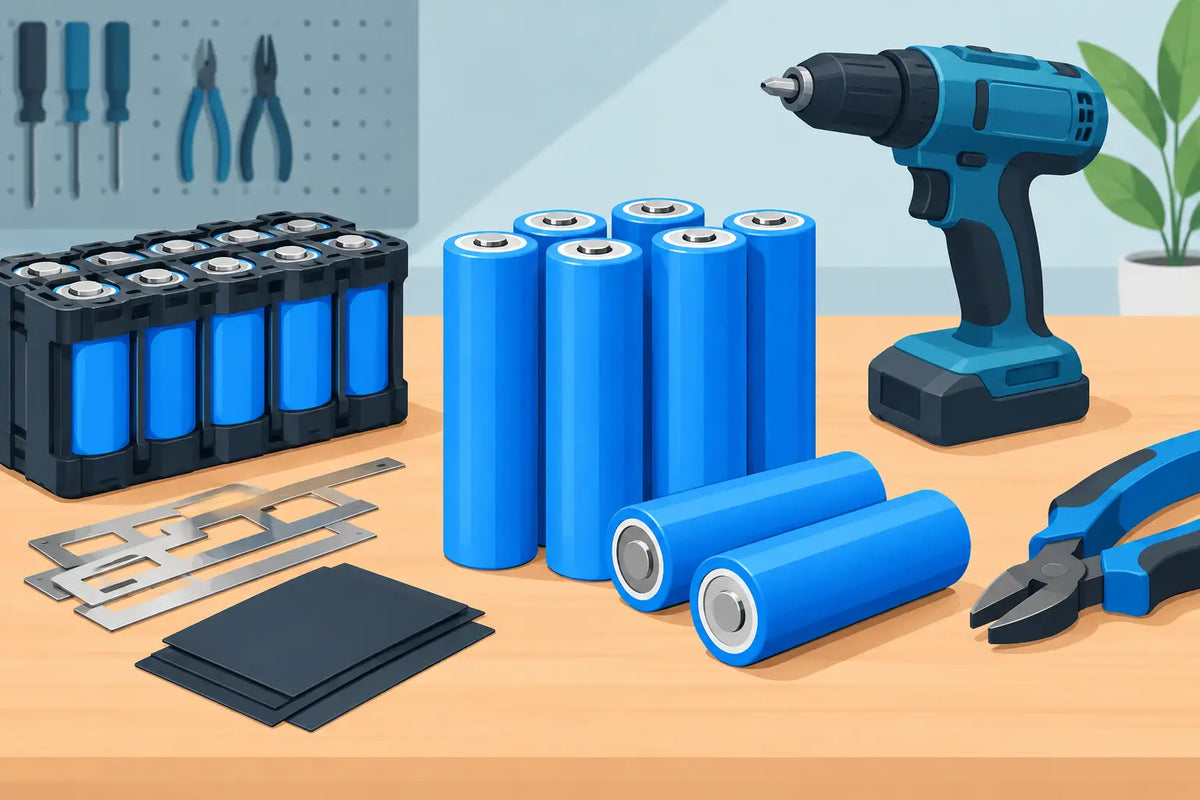
A cordless grinder that cuts out under load, or a drill pack that becomes too hot to hold, is rarely fixed by buying the highest mAh cell available. The best 21700 power tool cells are the cells that can supply the required current repeatedly, fit the pack correctly and stay within sensible temperature limits. For high-demand DIY packs, discharge performance matters just as much as headline capacity.
A 21700 cell is typically about 21mm in diameter and 70mm long. It offers more active material than an 18650, which can mean longer runtime, lower voltage sag or fewer parallel cells in a pack. That does not make every 21700 suitable for a power tool. Capacity-focused cells and high-drain cells are built for different jobs.
What makes a 21700 cell suitable for power tools?
Power tools place a hard, variable load on a battery. A drill may draw a brief surge when starting a hole, then settle as the bit turns. A circular saw, grinder or impact driver can repeatedly demand high current, particularly when the blade binds, the bit catches or the fastener is tight. The pack needs cells with a credible continuous-discharge rating, stable voltage under load and enough thermal headroom for repeated use.
The continuous-discharge rating is the number to prioritise. It is more useful than an optimistic pulse rating because tool work is not a single short burst. If a cell is rated for 45A continuous discharge under a manufacturer-defined temperature limit, it is designed to tolerate far more demanding use than a 10A or 15A high-capacity cell. The final pack current still depends on the number of cells in parallel, the BMS, nickel strip, weld quality and the tool itself.
Internal resistance matters too. A lower-resistance high-drain cell loses less voltage as current rises, so the tool sees firmer voltage and is less likely to feel flat early in the discharge cycle. That is why two packs with similar nominal voltage and capacity can perform very differently on the same tool.
For a pack used mainly in a work light, radio or low-load portable device, capacity may be the better priority. For cutting, grinding, drilling, garden tools and high-output DIY equipment, choose current capability first and accept the capacity trade-off where necessary.
Best 21700 power tool cells by job
No one cell wins every build. The right choice depends on whether the pack is expected to handle sustained high current, balance runtime with output, or replace cells in an existing pack design.
Molicel P45B 4500mAh 45A
The Molicel P45B is a strong all-round choice for demanding power-tool packs. Its 4500mAh capacity is useful for runtime, while its 45A continuous-discharge capability suits applications where heavy load and repeated acceleration are normal. It is particularly well suited to compact high-output packs, e-bike and scooter work, high-powered torches and serious DIY builds where voltage sag is unwelcome.
The trade-off is simple: a high-drain cell costs more than a low-current 5000mAh cell, and it is not necessary for every application. If the pack will only power low-draw equipment, the extra discharge capability may not provide a practical benefit.
Molicel P42A 4200mAh 45A
The Molicel P42A remains a proven high-drain 21700 option. With a 4200mAh nominal capacity and 45A continuous rating, it is built around output rather than maximum runtime. It is a sensible choice for hard-working tool packs where current demand is the first concern and the pack design benefits from a cell with an established reputation in high-drain applications.
Compared with the P45B, the P42A gives up some capacity. In return, it remains a capable option where consistent high-current performance is more valuable than squeezing out extra minutes between charges.
Samsung 40T 4000mAh 35A
Samsung's 40T is a practical high-drain cell for many demanding builds. Its 4000mAh capacity and 35A continuous-discharge specification place it below the 45A Molicel options for outright output, but it remains appropriate for a wide range of cordless-tool and mobility applications when the pack has enough parallel cells to share the load.
This is often a good fit where a well-known high-drain cell is required without designing around the most extreme current draw. As always, check the cell's current specification against the actual pack design rather than selecting it by brand alone.
Samsung 50S 5000mAh 25A
The Samsung 50S is worth considering when runtime matters but the tool is not an exceptionally high-current application. At 5000mAh, it offers more energy per cell than the high-drain options above, while its 25A continuous-discharge capability is still useful in properly designed multi-parallel packs.
It is not the first pick for a compact pack powering a grinder or other tool with aggressive current spikes. However, for lower-to-medium draw equipment, larger packs and projects where runtime is the priority, it can be the better engineering decision.
Calculate pack demand before choosing cells
A cell rating is not the same as a pack rating. In a parallel group, the current is shared between the cells. For example, a 10S2P pack has ten series groups for voltage and two cells in parallel per group for current sharing. If the tool draws 40A from the pack, each cell in an ideally balanced 2P group supplies about 20A.
That simple calculation is a starting point, not a complete design. Current sharing changes with cell resistance, temperature, cell age and connection resistance. Leave a margin rather than building a pack that operates at its cells' stated limit every time the trigger is pulled. The BMS must also be rated for the expected continuous and peak current, and its protection settings must suit the pack voltage and chemistry.
Nickel strip is another common weak point. Thin pure nickel is useful for corrosion resistance and spot welding, but it has a current limit. High-current packs may need appropriately sized nickel, copper reinforcement or a purpose-designed busbar arrangement. A high-drain cell cannot compensate for undersized interconnects or poor welds.
Flat-top cells, protection and pack compatibility
Most DIY power-tool battery packs use flat-top, unprotected cells with welded connections. Protected button-top cells are usually longer and can be unsuitable for tight pack holders, weld tabs and high-current discharge. Their protection boards may also trip under a tool's start-up surge.
Do not assume a 21700 pack will fit because the individual cells have the same format. Tool batteries often use moulded cell carriers, temperature sensors, proprietary contact layouts and electronic communication between the pack and charger. When rebuilding an OEM pack, retain or correctly replace the thermistor and protection hardware where applicable. Never bypass thermal protection, the BMS or a tool-pack fuse to stop nuisance cut-outs.
If the original pack used 18650 cells, a 21700 conversion may require a completely different mechanical layout. The larger diameter can affect case clearance, spacer fitment, terminal alignment and heat paths. Measure the available space before ordering cells.
Build with matched cells and sensible safety margins
For a new pack, use identical new cells from the same model and preferably the same batch. Do not mix brands, capacities, different discharge ratings, or old and new cells in one series or parallel group. Before assembly, check each cell for physical damage and confirm their voltages are closely matched.
Spot welding is the preferred method for attaching strip to cylindrical lithium-ion cells. Direct soldering puts unnecessary heat into the cell and can damage the internal seal or raise internal resistance. Use suitable fish-paper insulation, cell spacers where needed, insulating rings on positive terminals and secure strain relief for the pack wiring.
Charge the completed pack only with a charger matched to its series count and lithium-ion charge voltage. Store loose cells in proper cases, keep them away from metal objects in a toolbox or ute, and stop using any cell that is dented, swollen, overheated or has damaged wrap. End-of-life cells belong with an appropriate battery recycler, not in household rubbish.
For Australian builders choosing between high-drain and high-capacity 21700 cells, the useful question is not which cell has the biggest number on the wrapper. It is whether the cell, parallel count, BMS and connections are all rated for the work the pack will actually do. Build around that answer and the finished pack will be safer, cooler and far more useful at the tool.