
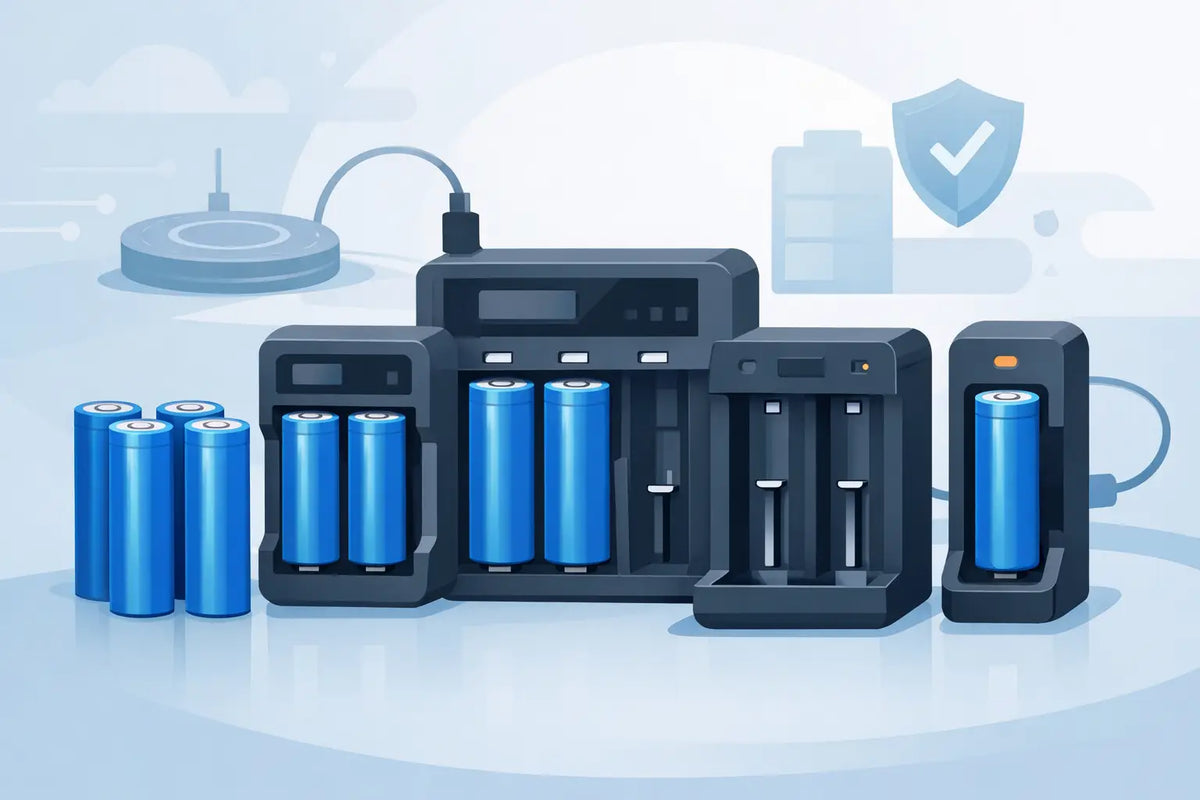
A 21700 cell may look like an oversized 18650, but assuming the same charger will fit is where many charging problems start. If you are asking which charger fits 21700 cells, check two things before anything else: the charger must physically accept the cell's length and diameter, and it must be designed for 4.2V lithium-ion chemistry.
Most modern multi-bay lithium-ion chargers support unprotected flat-top 21700 cells. The catch is that not every charger with an adjustable slot has enough travel for longer protected or button-top versions. A cell that fits only under pressure, sits crookedly in the bay, or prevents the slider from making proper contact is not compatible.
What size charger fits 21700 cells?
The 21700 designation describes a nominal cell size of approximately 21mm diameter and 70mm long. In practice, dimensions vary by manufacturer and configuration. An unprotected flat-top 21700 is generally close to 70mm long, while a button-top cell is slightly longer. Protected 21700 cells can be substantially longer again because of the protection circuit and added wrapper at the negative end.
For a standard unprotected flat-top 21700, choose a lithium-ion charger explicitly rated for 21700 cells or one with a maximum supported length of at least 71mm. For button-top cells, allow a little more room. For protected cells, confirm the actual maximum cell length in the charger specifications rather than relying on the word “universal”.
Diameter matters as well. Some compact chargers have narrow bays that suit 18650s but are tight around wider 21700 wrappers. A charger should hold the cell securely without scraping the wrap or forcing it into place. Damaged wraps are a short-circuit risk, particularly in metal-bodied chargers or when cells are later used in a battery holder.
Flat-top, button-top and protected cells
The terminal style does not change the required charging voltage, but it can change whether the cell reaches both charger contacts. Flat-top 21700 cells are common in power-tool packs, battery builds, high-drain torches and devices designed for bare cells. Button-top cells suit equipment that needs a raised positive terminal, while protected cells add electronic protection against over-charge, over-discharge and over-current.
A charger that fits an unprotected flat-top cell may not necessarily fit a protected button-top version. Measure the cell if you are unsure, especially if it has an added protection board. The published cell length is the figure to compare with the charger’s maximum supported length.
Choose the correct lithium-ion charging mode
Physical fit is only half the answer. Most 21700 rechargeable cells use standard lithium-ion chemistry with a full-charge voltage of 4.2V. Use a charger with a dedicated Li-ion or Li-ion 4.2V setting. It should charge using constant current followed by constant voltage, then terminate automatically when the cell reaches its proper full voltage.
Do not use a charger intended only for NiMH or NiCd rechargeable batteries. Those chemistries use a different termination method and are not interchangeable with lithium-ion cells. Likewise, do not select a 3.6V LiFePO4 setting for a standard 21700 Li-ion cell, and do not select a 4.35V high-voltage Li-ion setting unless the cell manufacturer specifically states that the cell is rated for 4.35V charging.
The word 21700 refers to size, not chemistry by itself. While most cells sold for this format are conventional 4.2V lithium-ion cells, the label on the cell and its data sheet should always take priority over assumptions based on size.
How much charge current should a 21700 charger provide?
A 21700 charger does not need to deliver extreme current to be useful. Many high-capacity 21700 cells are rated around 4000mAh to 5000mAh, and a charge rate between 0.5A and 1A per cell is a sensible everyday choice. It keeps heat down and is generally kinder to cell cycle life, though charging takes longer.
A 2A charging slot can be practical when the cell manufacturer allows it and you need a faster turnaround. For example, a genuine 5000mAh 21700 charged at 1A will take several hours from low charge, while 2A reduces the waiting time. The exact time depends on starting voltage and the slower constant-voltage stage near full charge.
Higher charge current is not automatically better. It increases heat, and a multi-bay charger may reduce current when several slots are occupied. Read the charger specifications carefully. A charger advertised as 4A total may provide 2A to one cell, 1A each to two cells, or a lower current across four occupied bays.
For everyday charging, prioritise a stable, independently controlled charger over headline current figures. A good unit detects each cell separately and does not treat cells in different conditions as if they were one matched set.
Features worth paying for in a 21700 charger
A basic charger can safely charge a suitable 21700 if it has correct Li-ion termination and a properly sized bay. For regular use, several features make operation safer and easier to check.
- Independent charging channels let each slot assess and charge its own cell. This is useful when cells have different capacities or starting voltages.
- Reverse-polarity protection helps prevent damage if a cell is inserted backwards.
- Over-charge protection and automatic termination stop normal charging at the selected full voltage.
- A clear display or status indicator shows whether each cell is charging, complete or rejected because of an error.
- A suitable power supply matters, particularly with higher-current desktop chargers. Use the supplied adaptor or a USB-C supply that meets the charger’s stated input requirement.
Check the cell before it goes in the charger
A compatible charger cannot make a damaged cell safe. Inspect every 21700 before charging. The wrapper should be intact, the positive insulator ring should be present, and there should be no dents, swelling, corrosion, leaking or unusual smell. Set aside any cell that becomes excessively hot, reports an error repeatedly, or has been physically damaged.
Do not charge loose cells in a pocket, toolbox or vehicle console, where keys, coins and tools can bridge the terminals. Use a proper plastic cell case for transport and storage. Keep charging on a hard, non-flammable surface away from direct sun, paper, solvents and other combustible materials.
Avoid unattended charging. Most quality chargers have safety protections, but those protections are not a reason to charge damaged cells or leave a charging setup without reasonable supervision. If the charger, cell or power adaptor becomes unusually hot, stop charging and investigate before trying again.
Charging 21700 cells for packs and high-drain devices
If you are charging loose 21700 cells for a battery pack, charge cells individually before assembly unless you have a purpose-built pack charger and correctly configured battery management system. A BMS is essential in a multi-series lithium-ion pack, but it does not turn an unsuitable charger into a safe charging solution.
Cells intended for the same parallel group should be the same model, age and condition, and should be brought to closely matched voltages before they are connected. Do not mix a new 5000mAh capacity-focused cell with an older high-drain cell because both happen to be 21700 size. The format matches; the electrical behaviour may not.
For e-bike, scooter, power-tool and custom portable-power packs, use the charger voltage specified for the complete pack and BMS configuration. A single-cell 21700 charger is for individual cells, not for charging a 10S, 13S or other series battery pack through improvised connections.
The practical buying check
Before choosing a charger, compare the cell’s actual length, diameter, chemistry and recommended charge current with the charger specifications. For most unprotected 21700 Li-ion cells, a charger that explicitly supports 21700 format, uses 4.2V Li-ion charging, and offers 0.5A to 1A per occupied slot is a dependable starting point.
If you use long protected 21700s, measure first and choose a charger with extra slot length. If you cycle several high-capacity cells each week, a multi-bay charger with independent channels and a genuine 1A or 2A-per-slot capability is usually the more practical option. A correctly matched charger protects the investment in genuine cells and gives your project a far better start than forcing a near-fit setup to work.